Garden Plan – March 2025
It’s that time of year again. We at the Romero Catholic Worker are craving sunshine and warmth after roughly 13 inches of snow and two “winter storms” between January and February here in Wichita. Our bodies are telling us that it’s time for fresh fruit and vegetables – broccoli, salad, tomatoes, peppers, cucumbers, melons. And our brothers and sisters living in tent encampments south of town along the river have expressed a desire for fresh vegetables to add to their meals. So to that end, we’ll be working as a community to sow seeds in the garden space graciously provided by the Lord’s Diner-Hillside, beginning this month and into May.
This is our first planting season, so our goal is to get acquainted with the soil and what it might need from us in order to be healthy and fertile and to learn what our crops have to teach us about their needs, given the specifics of place, climate, and daylight. We are beginning with the knowledge that we do have, and fully expecting to learn as we go. We are students; the Lord–through His Creation–will be our Teacher. While we intend to grow food and hope for abundance so that we can share with our neighbors, our goal is stewardship, not production. If this season we learn only what the soil and crops need, then we will consider this enough. We are sowing more than seeds; we are sowing hope, love for God and neighbor, and faith in God’s provision. We are sowing because we believe that our modern, consumerist, wasteful, exploitative society is not what we were made for as humans and because we believe in the significance of small actions, working toward a “society in which it is easier for people to be good.”
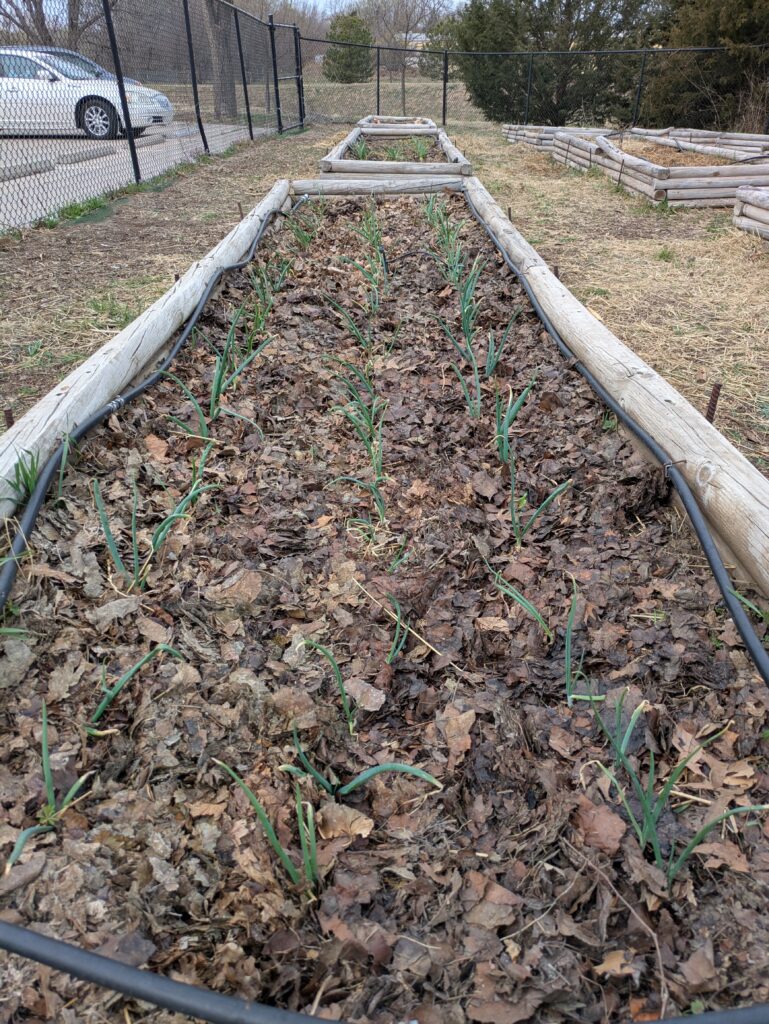
Right now, leaf mulch and some locally sourced horse manure and straw compost adorn our beds, in an effort to increase the organic matter of the soil. Winter peas have begun to sprout, serving as a soil cover and as a food crop. Broccoli and cabbage seedlings will be the first to grace the beds, followed by carrots, potatoes, spinach, and lettuce later this month. We will scatter beet, radish, turnip, and kale seeds among the other plants, to bring a diversity of roots to the soil and expand the possibilities for kitchen creativity. The curcubit family–melons, cucumbers, zucchini, and squash–will be sprawled out in no time, yielding a harvest through the summer and into late fall. Tomatoes, peppers, and sweet potatoes give us reason to look forward to the heat of summer here in the Plains. And while our space is too confined to plant the Three Sisters (the indigenous planting method of the Americas for corn, beans, and squash) in the traditional way, we still plan to attempt it in a modified way, with a small crop of corn and pole beans planted together.
Each plant contributes to the soil and the garden ecosystem in a different way. This is why we have chosen a variety of vegetables, many of which we will intercrop, so that the soil and the plants are enjoying the most possible benefits from each other’s company. Diversity also protects the harvest from devastation by pests, diseases, and weather; what affects one crop may be met with resilience from another.
The harvest will be distributed among our community and neighbors, and our monthly community dinners will feature seasonal ingredients grown in our garden. Who knows? Maybe we’ll have some recipes to share in the next issue of The Radix! Fresh produce lends itself well to a sort of accountability: our dialoguing about stewardship and responsible use and localism will now have reality to test our commitment. Before the tomatoes and zucchini and greens go to waste, we’ll have to be creative about how to use them, or return them to the soil in the form of compost. So maybe there will be breakfast burrito and salsa-making parties in RCW’s future …
Post-planting Update – June 2025
The spring planting season has come to an end in the Romero Catholic Worker garden. There have been slight changes to the planting plan – we opted for another bed of carrots in place of corn, and we’re experimenting with an unconventional trellis system for our tomatoes and peppers. What has not changed is the commitment to stewarding this soil well, and the encouragement and enthusiasm that continues to grow with the lengthening of days. We have been unexpectedly blessed by the generosity and goodwill of the Wichita community. Thanks to the friendly folks at Dutch’s, a local family-owned greenhouse, we have had access to any seeds, seed potatoes, and seedlings that we need, at no cost. High school students from the Kapaun-Mt. Carmel Ecology Club volunteered their time to start and tend sweet potatoes and tomato, pepper, and melon seedlings for us. The staff at the Lord’s Diner and Our Daily Bread food pantry have unwaveringly supported us with time, advice, practical knowledge, cardboard, tools, and their enthusiasm to see the garden up and running.
We met four times this season to work together preparing the soil, sowing seeds, transplanting, mulching, weeding, and getting familiar with the garden space. Each work day began with communal prayer to consecrate ourselves and our work to God, before dispersing to our different tasks. Quiet conversation, some teasing, and the laughter of children mingled with birdsong on those (usually) chilly mornings. Many of our workers joined us for more than one work day, preparing the soil in the very beds that they planted with sweet potatoes, melons, tomatoes, and cucumbers a few months later. There was a space for every person who showed up. For the strong backs, shovels of manure and straw to haul, and beds to broadfork. For the tactically-minded, a compost bin to assemble and trellises to erect. For the dextrous of hand, delicate transplants and tender roots to situate in the soil. We have a decluttered and organized shed and thriving potato plants, thanks to high school students from Kapaun-Mt. Carmel High School who came to help out on a few Saturdays. On several of our work days, our numbers included families with children, whose wee fingers planted seeds with tenderness and pulled the tiniest weeds often overlooked by adults. We give thanks to and for each person of any age who showed up to help us tend our soil. The soil that stayed on their hands longer than they may have wished is a pact, tying them to the life out here.
Peter Maurin’s vision of authentic community included communities that shared labor and worked together toward a common goal. The Romero Catholic Worker garden is many boasts shy of a farm, and still but a glimmer of a community garden, but this season, I (Mattie) felt that I was watching Peter Maurin’s vision come to life before me–modified though it may be–as friends and families bent their knees to the ground and thrust their hands into the soil, gently protesting more than just the supermarkets and fast food of our industrial agricultural system, but also the loneliness and listlessness of our society. The many hands and hearts, the motley crew of teachers, artists, students, handymen, parents, engineers, and kids was, to me anyway, proof that a “society in which it is easier to be good” is possible, we just have to make space for it. Some may call me an idealist and a romantic, but I think it changes a person to cup their hands around a young seedling and put it in the ground, hoping and willing it–expressed or not–to survive. And anyone who has ever gardened or farmed before knows that feeling of anxious waiting and watching to see if seeds will germinate, if sprouts will begin to push their way up out of the ground, if the transplants will establish themselves. What joy we feel when they do! Not all of ours have survived, but we will plant more. Even that loss is a lesson in fragility and attentiveness, a reminder that there is so much hope in springtime and that it is a gift to touch with our hands the real cycle of death and resurrection in the soil.
Changing seasons – September 2025
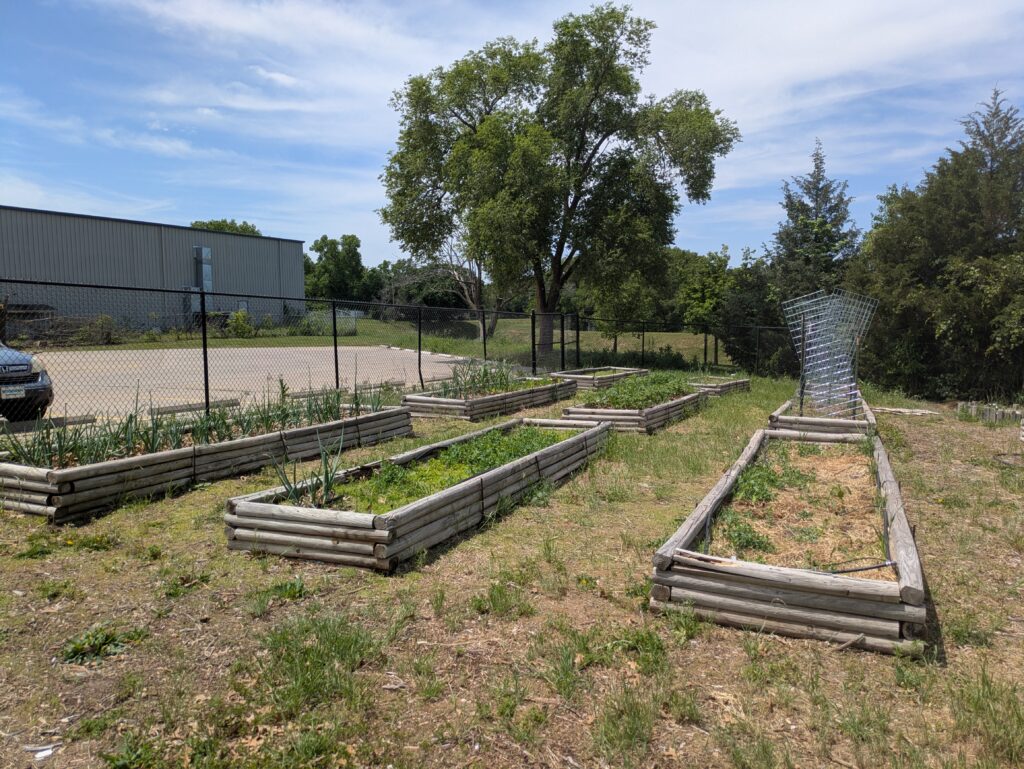
There has been a “changing of the guard” out at the Catholic Worker garden. At the time we published the last issue of the Radix, the onions — our sentinels tall and proud, their woolly tufts bobbing in the breeze (only because they had gone to seed after enduring the stress of overwintering) — were greeting the first days of summer sun. Vigorous potato plants, deeply green and full, held down the fort mid-garden, and a verdant sea of feathery carrot tops rippled over the bed in the southwest corner of the garden plot.
Now, three and a half months later, tomatoes and okra have taken the place of the alliums as custodians of the garden. There was a time we were worried the tomatoes would not survive transplant shock, but they have taken off, spilling beyond the confines of the means we have used to contain them (on one bed, we have employed the Florida-weave method, trellising on twine woven between an 8-foot stand of t-posts; on the other bed, we erected cattle panels and have tied the tomato plants to them as they grow). The cucurbits, too (squash, zucchini, melons), have surprised us, refusing to surrender to the heat. With some pollination assistance, the fruit are growing, and the vines are spreading. Sweet potato vines, also, have sprawled out over their bed, promising an ample harvest of late-summer gold later this month. And burgundy okra plants have stretched outwards and upwards, yielding bucketfuls of hearty okra for crunching raw, frying, and making soup.
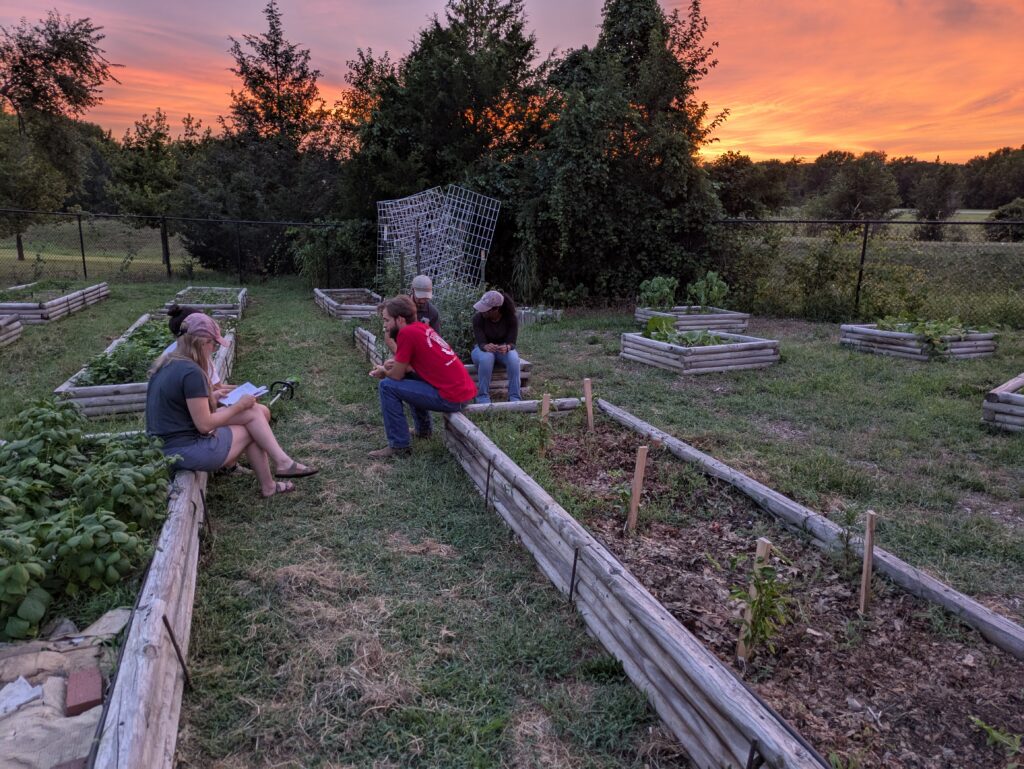
This season’s lesson is one of humility. We set out to listen to the soil and plants, and what has come across loud and clear is that we are not in control; we have been disappointed by failures in spite of our best efforts and surprised by returns in spite of our worst. Plants (including weeds!) are resilient, but even so, the soil has certainly cried out to us for attention. There was a conspicuous shortage of pollinators this season, as evidenced by the limp, wannabe fruit on multiple squash plants. Most of the cucumber vines mysteriously died, and the peppers just haven’t taken to the soil (nor, probably, to the unusual amount of rain we’ve received in Wichita this summer). My cheeky distaste for pulling anything out of the ground was equalled and mocked by the cheekiness of summer grasses and weeds that quickly took over. I am grateful for the crew that has faithfully reported for duty at Monday night garden hours and helped keep the opportunistic vegetation at bay. Still, in the fertile soil of humility have sprouted seeds of hope, and curiosity. Other than a few incidents, pests and diseases have been minimal and we have received periodic rainfall all summer long, which is unusual (but not unwelcome!) in our region. We have aided the squash by hand-pollinating, we are working on building up soil nutrients using mulches and cover crops, and improving soil structure by planting a diversity of roots and avoiding tillage.
In June, we harvested the onions, which are now drying in recycled bread trays, and pulled up handsome bulbs of garlic which are now braided and drying in the shed. In July, we dug the potatoes, astonishingly plentiful, hiding there in the dark under leaf mulch and soil. In August, we harvested bucketfuls of okra, plentiful tomatoes, and a few oversized Armenian cucumbers. The produce has been put to good use: though the harvest of carrots, turnips and cabbage was meager, it was enough to store (blanched and frozen) until this winter, when they’ll feature in soups and stews that we take to the homeless camps south of town; the tomatoes, onions, and cucumbers made a toothsome pasta salad for the Labor Day Feed that we helped put on downtown; and the potatoes and sweet potatoes we’ll store through the winter, using what we can for hearty soups and chilis to warm our unhoused neighbors. Speaking of winter, the next few months will see us planting a few more broccoli and cabbage plants and some greens to continue harvesting through the Fall, and by December the beds will be winterized, covered in layers of straw and leaf mulch, and we’ll hunker down for another Wichita winter. But we do hope to keep fellowshipping out there until its arrival, enjoying the fruits of our labor and soaking in the sunshine with Monday garden hours, work days, and community dinners.
Second season update – May 2026
It is the beginning of the second season at the Romero Catholic Worker garden. What a blessing to be able to say that! Last season taught us to be more hospitable to our pollinating neighbors, and less hospitable to our pernicious ones (squash bugs). We are excited for a crop of onions that won’t go to seed since they didn’t overwinter this time around. God willing, we learned our lesson with the carrots and are taking extra care to keep the soil surface soft and evenly watered so they are able to germinate. The compost pile that we began building a year ago has now provided nutrient-rich soil starter for our beds, and we are adding to another pile for next season (if you are looking for a place to send your food scraps/organic waste, let us know! We can provide countertop containers). We have used nearly all that we were able to save from last season’s crop, in soups to take downtown and to the camps, so we plan to plant more of the most productive vegetables from last year—potatoes, green beans, peppers, sweet potatoes, tomatoes—so that we can preserve them properly for the months to come (if you live in the area, we hope to host a community canning/preserving day in late summer/early fall). And new this year, since we have established a rhythm of care for the garden and a plan for planting, we can focus our attention on more labor-intensive projects around the space.
RCW Garden Workshop Schedule Summer 2026:
On June 20th, we’ll be hosting a workshop to build a solar dehydrator. This is a functional design, based off of the one used at Salamander Springs Farm in Kentucky, which will allow us to dry herbs, tomatoes, fruit, and flowers, using exclusively the heat of the sun.
On July 25th, we’ll be hosting a workshop to construct an herb spiral, which will be planted with herbs once temperatures cool down.
Stay tuned for more workshop information! If you would like to be put on the email list to receive Romero Catholic Worker updates, please drop your email here: